



Rodwajlery is a spelling encountered in searches and Polish-language writing about Rottweilers. The recognized breed name is Rottweiler. Treating the unfamiliar spelling as a newly discovered breed would create confusion: the useful starting point is the established working dog and the responsibilities that come with caring for one.
A Rottweiler’s striking appearance tells only part of the story. Before bringing a dog home, consider your schedule, handling experience, household routines and access to appropriate support. This guide separates the name question from practical ownership planning. The images are AI-generated illustrations, not photographs of dogs offered for sale or adoption.
Rodwajlery and the recognized breed name
The American Kennel Club’s Rottweiler profile identifies a strong working breed with historical connections to Roman mastiff-type dogs. A Polish Rottweiler puppy guide explicitly records rodwajlery as a colloquial name. That supports the spelling connection without turning it into a separate pedigree classification.
When checking a breeder’s paperwork or a rescue listing, use the name shown in the actual records. Do not assume an unusual spelling proves rarity, superior quality or a special bloodline. Our guide to checking similar spellings explores the same research habit in a different context: retain the original term while checking the established reference.
| Question | Useful starting point |
|---|---|
| Recognized breed | Rottweiler |
| Search variation | Rodwajlery |
| General build | Large and powerful |
| Planning priorities | Handling, training, exercise and household fit |
| Individual assessment | More useful than a stereotype |
Start with the individual dog
Breed descriptions summarize tendencies; they do not predict every animal’s response to a visitor, another dog or an unfamiliar sound. Meet the particular dog and ask its current carer about ordinary situations. How does it settle after a walk? What happens when someone approaches the door? What handling has it experienced comfortably?
Write down examples rather than accepting vague labels such as friendly or protective. Ask what a label means in practice and in which setting the behaviour was observed. A dog that relaxes at home may behave differently in a crowded place. That difference is information to work with, not a reason to invent a fixed personality from a photograph.
Make training part of the daily routine
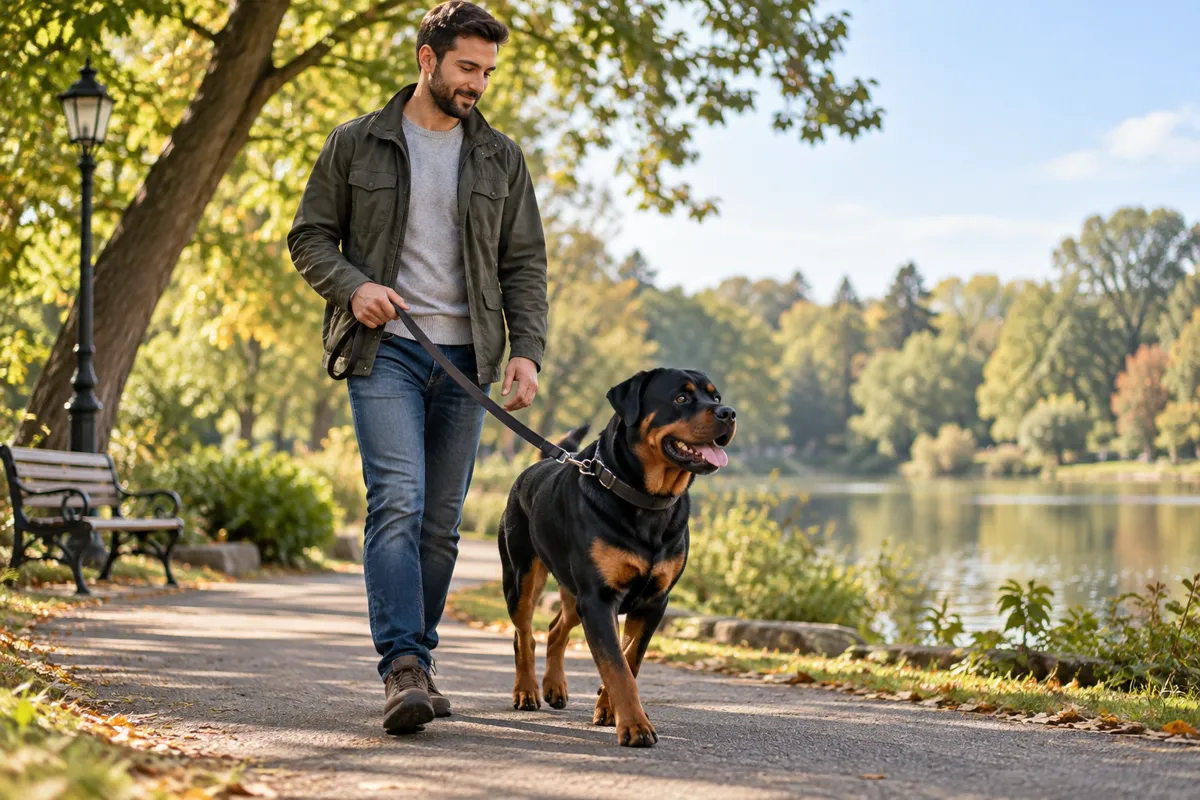
Blue Cross recommends reward-based training and discourages aversive methods. A useful planning approach is to identify a few everyday skills: responding to a name, walking calmly with a handler, waiting while a door opens and settling in a designated place. Work with a qualified professional when support is needed.
Agree on the household’s cues before practice begins. If one person invites jumping while another pushes the dog away, the routine becomes unclear. Keep a small record of the setting, what you asked for and what happened. This helps a trainer identify the actual difficulty instead of receiving only the statement that the dog will not listen.
Do not make protection or intimidation the goal of ordinary family training. Focus on predictable handling and cooperation. If a situation creates distress or unsafe behaviour, create distance and seek qualified guidance rather than testing how much pressure the dog will tolerate. A powerful dog needs thoughtful management even when previous interactions have gone well.
Plan activity around real needs
The PDSA breed guide describes Rottweilers as active dogs and gives a general adult exercise recommendation of at least two hours daily. It also emphasizes socialisation and consistent reward-based training. An individual plan should reflect age, health and veterinary advice; an adult recommendation is not an automatic target for a puppy.
Map the routine onto your actual week. Who handles the morning outing when work starts early? What happens during bad weather? Who provides care when the regular handler is away? A realistic answer includes alternatives and named responsibilities. A large garden alone does not answer questions about companionship, training or purposeful activity.
Prepare the home before arrival
Choose a resting area where the dog can withdraw from household traffic. Plan where equipment will be kept, how visitors will enter and how feeding will be managed. Discuss boundaries with every member of the household rather than trying to negotiate them during the excitement of the first day.
Children and dogs require active adult supervision. Make space and rest part of the household rules, including leaving the dog alone while eating or sleeping. The PDSA highlights the breed’s strength and advises careful consideration for homes with young children. Ask a rescue or qualified professional to assess the particular match rather than relying on a general family-friendly label.

Keep care records simple and useful
A notebook can hold the dog’s identification, veterinary contact, food details, medications prescribed by a vet and relevant appointment dates. Add observations in plain language: what changed, when it started and how often it occurred. These records help you communicate accurately without attempting to diagnose a problem yourself.
Ask a veterinarian about appropriate preventive care and any breed-relevant screening. When considering a puppy, ask for actual parental health-test documentation and help interpreting it. The PDSA identifies inherited and joint-related concerns among the issues relevant to this breed. A health claim in an advertisement should be supported by records, not treated as a guarantee.
For grooming, choose tools and a routine appropriate to the dog’s coat and tolerance. Introduce handling calmly and seek help if touching a particular area causes discomfort. Keep your aim practical: a dog that can be checked and cared for comfortably, rather than a photographically perfect appearance at any cost.
Questions people ask about rodwajlery
Is rodwajlery a separate breed? The sources used here connect the spelling with Rottweilers. Use the recognized breed name when checking registration, care information and professional advice.
Does a strong build mean an aggressive personality? Appearance alone does not establish behaviour. Consider the individual dog’s history, current responses, environment and handling.
Is a puppy easier than an adult dog? Each brings different responsibilities. Ask what support, history and assessment are available, and compare those needs with your household’s experience.

Choose the commitment, not the label
Make a written plan before committing: daily care, training support, veterinary costs, travel arrangements and emergency cover. Our Lucipara name guide also shows why identifying the right animal or subject comes before collecting facts about it. With rodwajlery, resolving the spelling is the easy part; building a workable life for the individual dog is the decision that matters.
