



Fascisterne is a Danish word that translates most directly as “the fascists.” It is the definite plural form of fascist, referring to a specific group of people who support fascism or belong to a fascist movement. The word carries serious historical and political meaning, so it should not be treated as a mysterious internet invention or used casually as a label for anyone with an unpopular opinion.
This guide explains the grammar behind fascisterne, the established meaning of fascism, and the Danish historical context in which the word may appear. It separates dictionary evidence from political interpretation and gives readers a practical method for understanding the term in articles, archives and modern debate.
The historical images in this guide are AI-generated educational illustrations, not archival photographs.
Fascisterne at a glance
| Point | Accurate explanation |
|---|---|
| Language | Danish |
| Base noun | fascist |
| Plural form | fascister |
| Definite plural | fascisterne |
| Direct English translation | the fascists |
| Typical use | A specific group associated with fascism |
| Important caution | Context is needed before applying the label to people or organisations |
What does fascisterne mean?
The Den Danske Ordbog entry for fascist defines the noun as a supporter of fascism and supplies the grammatical forms used in modern Danish. The Danish–English dictionary entry likewise shows the pattern fascist, fascisten, fascister, fascisterne.
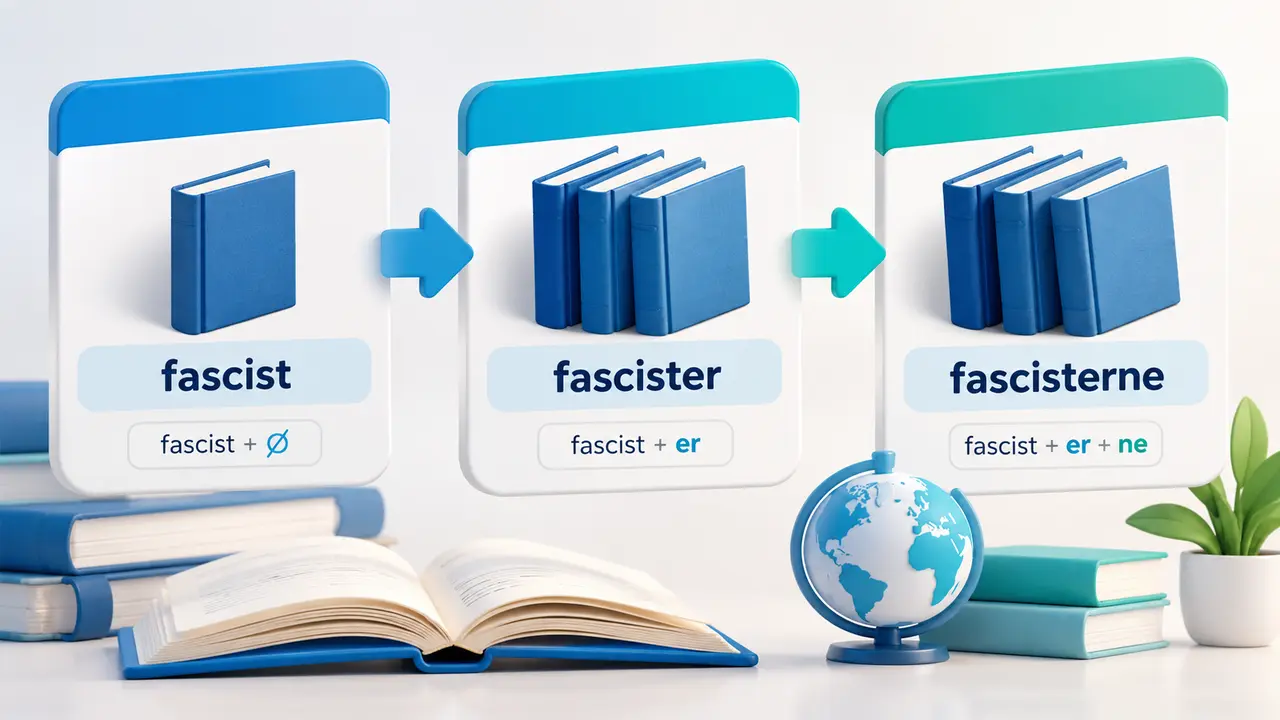
That pattern matters. Fascist is an indefinite singular noun: “a fascist.” Fascisten means “the fascist.” Fascister means “fascists,” while fascisterne means “the fascists.” The final -ne marks the plural as definite, indicating a particular group already known from the sentence or surrounding discussion.
How Danish grammar forms fascisterne
Danish often attaches definiteness to the end of a noun rather than placing a separate equivalent of English “the” before it. For this noun, the plural ending is -er, producing fascister. Adding the definite plural ending -ne produces fascisterne. It can therefore be analysed as fascist + er + ne.
Capitalisation depends on position, not ideology. In ordinary Danish prose the word is normally lowercase unless it begins a sentence or appears in a title. Possessive forms may add -s, as in fascisternes, meaning “the fascists’.” Readers comparing unfamiliar European terms may also find our guides to Nahttypen, Messonde and Sammying useful examples of checking grammar and technical context before guessing a definition.

What fascism means in historical scholarship
The word fascisterne cannot be understood responsibly without the ideology it names. The United States Holocaust Memorial Museum describes fascism as an ultranationalist and authoritarian political philosophy. It links fascism with militarism, opposition to pluralism and democracy, suppression of individual rights, and the subordination of individuals to the nation.
Fascist movements differed across countries, and scholars continue to debate precise boundaries. However, the term is historically associated with organised movements and regimes that rejected democratic competition, elevated an authoritarian leader or state, mobilised nationalism and forcibly suppressed opponents. It is more specific than “strict,” “rude” or “controlling.”
That distinction prevents two errors. The first is minimising historical fascism by turning the term into a casual insult. The second is avoiding the word when a movement’s documented programme, organisation and conduct genuinely fit the historical concept. Accurate use requires evidence, not merely anger.

Fascisterne in Danish historical context
In historical Danish material, fascisterne may refer to Italian Fascists, German Nazis, Danish fascist or Nazi organisations, or fascist forces discussed in relation to the Spanish Civil War and the Second World War. The exact reference comes from the surrounding document. A newspaper sentence about “fascisterne” in Italy does not automatically describe Danish members, and a wartime resistance text may use the term more broadly for occupying or collaborating forces.
Denmark was occupied by Nazi Germany from 1940 to 1945. Its government initially followed a policy of cooperation while Danish institutions continued under occupation, but conflict and resistance intensified. The Museum of Danish Resistance presents this period through the choices faced by people involved in resistance, collaboration and daily survival. That institutional context is more dependable than simplified claims that every Dane resisted or every participant made the same choice.
Why context changes the translation
“The fascists” is the direct translation, but a polished English translation may identify the group more precisely when the Danish source does. Depending on context, it could become “the Fascists,” “the fascist movement,” “fascist supporters” or the formal name of a party. Translators should not replace the word with “Nazis” unless the source clearly refers to Nazis, because fascism and Nazism overlap historically but are not interchangeable in every sentence.
Pronouns and nearby nouns also matter. If an earlier sentence names Italian Fascists, a later fascisterne probably refers back to them. In a modern opinion column, the writer may be making a contested characterisation rather than stating a formally documented affiliation. A translation should preserve that distinction by attributing the label to the speaker when necessary.
How to use fascisterne accurately
- Read the full sentence. Identify who “the fascists” refers to before translating.
- Check the date and place. A 1920s Italian source and a 1940s Danish source may name different groups.
- Prefer formal evidence. Party programmes, membership records, archives and scholarly histories are stronger than social-media labels.
- Keep categories distinct. Do not automatically treat fascist, Nazi, authoritarian, conservative and nationalist as synonyms.
- Attribute disputed labels. Write that a speaker “called” a group fascisterne when the classification is part of an argument.
- Avoid casual insult. The term carries a history of dictatorship, persecution and political violence.
Frequently asked questions
Is fascisterne singular or plural?
It is definite plural. The singular is fascist, the ordinary plural is fascister, and fascisterne means “the fascists.”
Is fascisterne the same as Nazis?
Not automatically. Nazis are associated with National Socialism, while fascisterne is the broader Danish term for “the fascists.” Context may show that a writer means Nazis, but translators should not assume it.
Can fascisterne be used figuratively?
It can appear rhetorically in political argument, but that does not make every use historically precise. Readers should distinguish an attributed accusation from a documented ideological classification.
How is fascisterne pronounced?
Danish pronunciation differs from an English reading, and regional speech can vary. For accurate audio, use a reputable Danish dictionary pronunciation rather than spelling the word phonetically from English.
Precision matters more than the label
Fascisterne has a straightforward grammatical meaning—“the fascists”—but responsible interpretation requires more than a one-line translation. Identify the group, period, speaker and evidence. Keep fascism distinct from nearby political terms, and remember that historical sources may use labels differently from modern commentators. With that context, the Danish word becomes clear without stripping it of its serious historical weight.
