


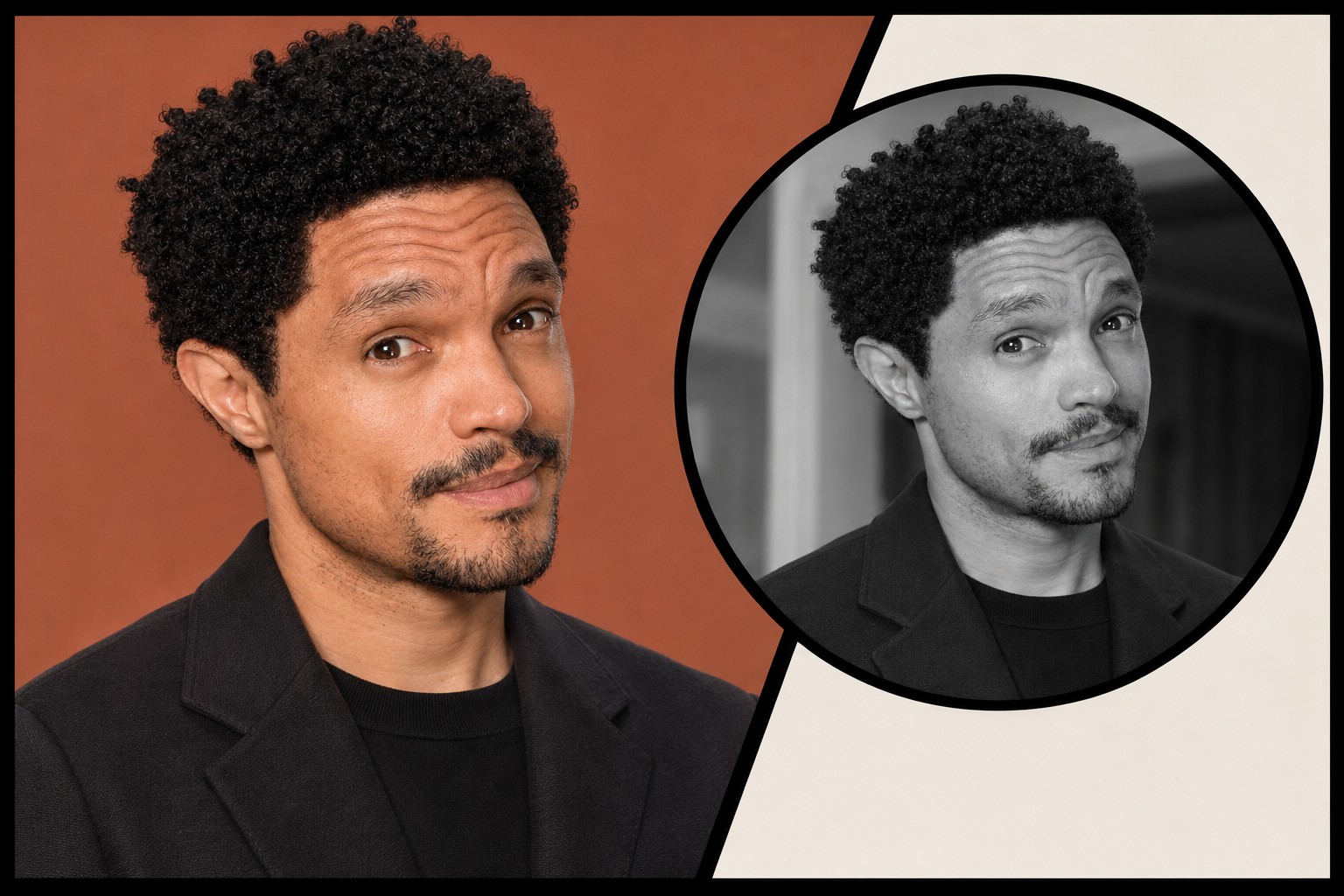
Trevor Noah is a South African comedian, author and presenter whose career connects stand-up, political satire, memoir and long-form conversation. He became internationally familiar as the host of The Daily Show from 2015 to 2022, while Born a Crime introduced readers to the family experiences behind his perspective.
His comedy often begins with a difference in language, culture or expectation and asks why something familiar to one audience seems strange to another. That approach reflects a childhood in a divided South Africa and a working life that later took him across countries. Since leaving daily television, he has continued performing, hosting, writing and developing projects through his production company and education foundation.
Quick facts
| Name | Trevor Noah |
| Born | 20 February 1984 |
| Age | 42 as of November 2026 |
| Birthplace | Johannesburg, South Africa |
| Work | Comedian, author, presenter and producer |
| The Daily Show | Host from 2015 to 2022 |
| Memoir | Born a Crime (2016) |
| Later book | Into the Uncut Grass |
| Podcast | What Now? with Trevor Noah |
| Foundation | Trevor Noah Foundation, launched in 2018 |
| 2026 special | Joy in the Trenches |
Early life in South Africa
Noah was born on 20 February 1984 in Johannesburg. His mother, Patricia, is a Black South African woman, and his father, Robert, is white and Swiss. He was born during apartheid, when laws regulated relationships across racial categories.
The title Born a Crime refers to that context. It does not mean that a baby committed an offence; it points to the criminalisation of his parents’ relationship and the pressures that shaped the family’s everyday decisions.
His childhood unfolded during the final years of apartheid and the transition that followed. The political changes were therefore not simply events he studied later. They formed the environment in which his family navigated school, work, language and belonging.
Patricia Noah and the family story
Patricia is central to Noah’s account of his childhood. In his memoir, she is a parent whose determination, faith and expectations help shape his ambitions. The relationship gives the book an emotional centre beyond the history surrounding it.
Penguin Random House’s description of Born a Crime presents the book as a collection of stories about a South African childhood. It is a personal narrative, which means its particular experiences should not be treated as a complete account of every family living under the same system.
Noah’s public storytelling often returns to the distance between a child’s understanding and an adult’s later interpretation. The humour can arise from that gap while leaving the seriousness of the experience intact.
Language, education and observation
Language is especially important in Noah’s account of growing up. Different ways of speaking could change how people understood him and which group they assumed he belonged to. That awareness later became part of his comic technique.
His impressions are not only displays of an accent. They often reveal a social expectation: how a person performs authority, how a listener misreads confidence or how familiar words acquire a different meaning in another setting.
For a biography, the useful connection is between observation and craft. A multilingual environment can provide material, but turning it into a clear story for an unfamiliar audience requires selection, explanation and timing. Those are skills developed through performance.
The South African entertainment career
Before The Daily Show, Noah had already worked in South African television, radio and stand-up. The international breakthrough did not mark the beginning of his professional life; it brought a wider audience to a performer with substantial experience.
Stand-up offered a way to connect personal stories with broader questions about national identity and cultural misunderstanding. Performing abroad then required him to decide which assumptions could be shared and which needed to be explained.
That process is part of what distinguishes his comedy from a simple transfer of local jokes to a larger stage. He often gives an audience enough context to recognise a situation before revealing the contradiction within it.
Joining The Daily Show
Noah became a correspondent on The Daily Show before succeeding Jon Stewart as host in 2015. Taking over an established programme meant inheriting both its strengths and an audience with clear expectations.
The role combined several jobs. A host delivers jokes, interviews guests, works with writers and represents the programme’s point of view. Political satire also requires the audience to understand enough of the underlying event for the joke to make sense.
Noah’s international perspective became one of the tools he brought to the format. He could compare an American argument with experiences elsewhere, making something that seemed normal in one national conversation look unfamiliar from another angle.
Seven years at the desk
His tenure ran from 2015 to 2022, covering several major changes in American politics and the disruption of the pandemic. The programme’s presentation evolved during that period, including the shift away from a conventional studio format during lockdowns.
A nightly or near-nightly topical programme differs from touring stand-up. Material must respond to a rapidly changing news cycle, and a joke can lose its relevance quickly. The work depends on a team as well as the recognisable person at the desk.
The Television Academy’s record documents recognition connected with his television work. His departure from the show changed the schedule and format of his career, but it did not mean he stopped performing or discussing public life.
Born a Crime and its readership
Published in 2016, Born a Crime became a major part of Noah’s identity outside television. A reader does not need to know his delivery from a comedy stage to follow the stories, which move between family incidents and the wider conditions surrounding them.
The memoir format allows a different pace from a television segment. A situation can be developed gradually, and an apparently comic episode can acquire a more painful meaning as the reader understands what was at stake.
A young-readers adaptation followed. The publisher’s author page provides a route to the editions and related work. The book’s success demonstrates that his audience is not limited to people who followed American late-night television.
Stand-up specials and touring
Noah continued releasing stand-up work alongside and after his television years. His Netflix specials include Afraid of the Dark, Son of Patricia, I Wish You Would and Where Was I. Each offers a more extended performance than the short segments associated with The Daily Show.
Joy in the Trenches, listed by Netflix in 2026, adds to that catalogue. His official shows page is the appropriate place to check current touring information.
The relationship with the audience is different on tour. A story can grow over several minutes, return to an earlier idea and build toward a payoff that would not fit a brief news segment. That longer structure is an important part of his work.
What Now? and the conversation format
What Now? with Trevor Noah places him in extended conversations with guests from different fields. His official media page describes the podcast and links it with his wider body of work.
The format gives him room to ask follow-up questions and allow an answer to move beyond the predictable promotional response. Humour remains part of the exchange, but the conversation does not have to produce a punchline every few seconds.
For audiences, the distinction matters. A stand-up special is a constructed performance; an interview is a developing interaction. Noah’s career now includes both, and each reveals different aspects of his curiosity and communication style.
Books, hosting and production
Noah’s later book Into the Uncut Grass extends his publishing work beyond the autobiographical form of Born a Crime. His official biography lists both books alongside the podcast and his production company, Day Zero Productions.
He has also hosted the Grammy Awards repeatedly, returning for a sixth consecutive ceremony in 2026. An awards host has to manage a live event’s rhythm, introduce performers and respond to unexpected moments without becoming the entire focus.
Production work adds another responsibility: helping projects exist beyond his own appearance in them. His official biography describes Day Zero’s film and television activity, making clear that his professional role is broader than presenter alone.
The Trevor Noah Foundation
Noah launched the Trevor Noah Foundation in 2018 in South Africa. Its work focuses on education, including support for schools, teachers and learners. This is an organised programme rather than simply a general statement of charitable interest.
The Khulani Schools Programme is described by the foundation as its flagship intervention. Its approach includes teacher development, student skills and educational infrastructure.
The connection with his biography is clear: education and opportunity are recurring themes in his account of growing up. The foundation’s own reports are the best basis for assessing particular activities and results, rather than assuming every project can be attributed to one person working alone.
Private life, net worth and a changing career
Noah shares selected family experiences through his books and performances, but a public career does not make every detail of his current private life public. His professional biography can be explained without turning dating speculation into a fixed personal status.
His exact net worth is also not independently established by the sources used here. Television, touring, publishing, hosting and production are documented parts of his work; the total value of his private finances is a different question.
What connects these activities is a recognisable method: start with a human encounter, identify the assumption beneath it and explain the difference to another audience. That method has travelled from South African stages to international television, books and conversations.
Frequently asked questions
How old is Trevor Noah?
He was born on 20 February 1984 and is 42 as of November 2026.
When did Trevor Noah host The Daily Show?
He hosted the programme from 2015 to 2022, succeeding Jon Stewart after first appearing as a correspondent.
Why is his memoir called Born a Crime?
The title refers to the apartheid-era criminalisation of his parents’ interracial relationship. The book explores his childhood and family experiences.
What is Trevor Noah’s podcast?
His podcast is What Now? with Trevor Noah, featuring extended conversations with guests from entertainment, public life and other fields.
What does the Trevor Noah Foundation do?
Founded in 2018, it supports education in South Africa, including work with schools, teachers and learners through programmes such as Khulani.
