


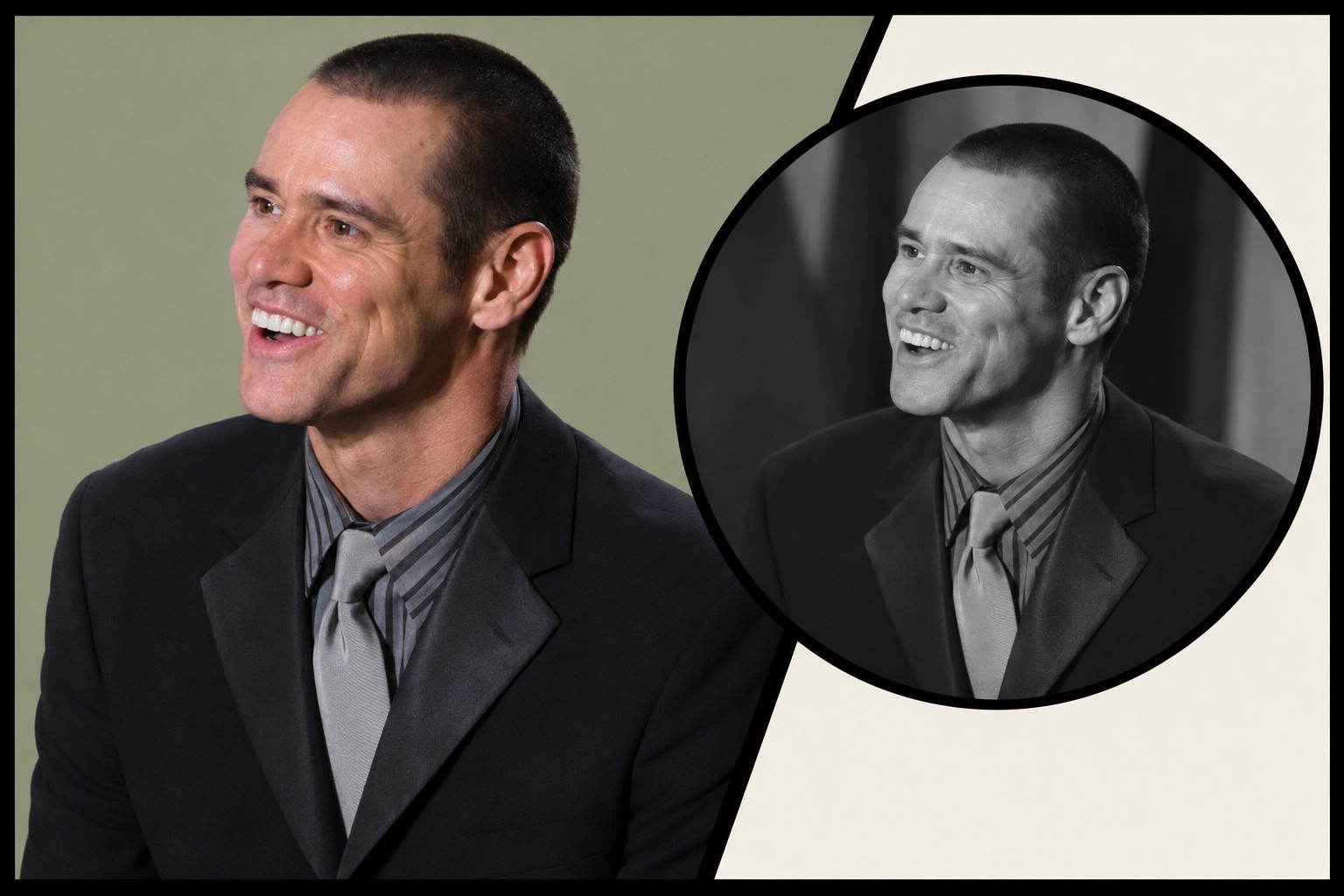
Jim Carrey is a Canadian-American actor and comedian whose physical performances helped define popular film comedy in the 1990s. Ace Ventura: Pet Detective, The Mask and Dumb and Dumber made him a major star in a single year. He later challenged that image with The Truman Show, Man on the Moon and Eternal Sunshine of the Spotless Mind.
His biography includes much more than an elastic face and a string of box-office hits. It begins with a financially difficult family period in Canada, continues through stand-up and sketch television, and expands into painting, writing and selective returns to film. The contrast between spectacular comedy and quieter emotional work is central to understanding his career.
Quick facts
| Full name | James Eugene Carrey |
| Born | 17 January 1962 |
| Age | 64 as of November 2026 |
| Birthplace | Newmarket, Ontario, Canada |
| Nationality | Canadian-American |
| Work | Actor, comedian, writer and visual artist |
| Breakthrough year | 1994 |
| Major television credit | In Living Color |
| Daughter | Jane Carrey |
| Golden Globe wins | The Truman Show and Man on the Moon |
| Novel | Memoirs and Misinformation, with Dana Vachon |
Early life in Ontario
Carrey was born on 17 January 1962 in Newmarket, Ontario. His parents were Percy and Kathleen Carrey, and he was the youngest of four children. Comedy and impressions were interests well before he became a professional performer.
The family experienced financial hardship during his adolescence. Accounts of those years describe the children working alongside their parents and Carrey leaving school before completing a conventional academic path. These circumstances form part of his early biography, rather than a simple explanation for everything he later achieved.
Canada’s Walk of Fame records the development of his career and honours his contribution to entertainment. His Canadian upbringing remains an important part of his public identity even after decades of work in the United States.
Stand-up and the move toward Hollywood
Carrey developed his act in comedy clubs, using impressions and an unusually flexible physical style. Stand-up gave him immediate feedback: a voice, face or movement either communicated the joke to the room or needed to be changed.
Moving into American entertainment required more than demonstrating that range. A club act can move quickly among impressions, while a film character has to sustain an identity across a story. His early screen work was part of learning how to make those skills serve a longer performance.
This period is important because his 1994 breakthrough can make the preceding years disappear from view. The sudden visibility rested on a much longer stretch of auditions, stage work and screen opportunities that did not all produce major success.
In Living Color
The sketch series In Living Color gave Carrey a prominent television platform in the early 1990s. Working within an ensemble, he could push physical behaviour to extremes while still responding to the pace and structure of a short sketch.
Sketch comedy also requires clear choices. The audience needs to understand a character almost immediately, often before the scene has explained much. Carrey’s ability to transform posture, voice and facial expression was particularly suited to that demand.
The programme helped establish his recognisable comic identity before the film breakthrough. It is therefore an essential part of the career, not a minor television footnote preceding Hollywood success.
Three major comedies in 1994
In 1994, Ace Ventura: Pet Detective, The Mask and Dumb and Dumber introduced different versions of Carrey’s comic range to a mass audience. The concentration of those releases made the year a decisive turning point.
Ace Ventura built a film around an aggressively eccentric character. The Mask placed his physical performance alongside visual effects and cartoon logic. Dumb and Dumber paired him with Jeff Daniels, making the friendship and misunderstandings between the characters as important as the individual comic moments.
The films differ substantially, but all depend on Carrey committing completely to an absurd premise. He does not merely comment on the silliness from outside it. The character behaves as if the ridiculous situation has its own consistent rules.
The Cable Guy, Liar Liar and changing expectations
Later 1990s films tested what audiences expected from him. The Cable Guy gave his intensity a more unsettling quality, while Liar Liar placed an extreme comic restriction inside a story about a father and son.
These roles demonstrate how the same physical gifts can have different effects. A sudden movement can be delightful in one film and intrusive in another. A face held too long can become uncomfortable rather than reassuringly funny.
Carrey’s career is partly a history of those changing expectations. Once audiences recognised a particular kind of performance, he could satisfy it, complicate it or use it to make a darker idea more surprising.
The Truman Show
The Truman Show, released in 1998, cast Carrey as Truman Burbank, a man whose ordinary life is secretly organised as television entertainment. The role uses his likeability while gradually making familiar routines feel strange.
The performance is effective because Truman’s curiosity develops into a serious need for freedom. Carrey does not abandon comic timing, but he allows uncertainty and fear to occupy the same character. The viewer has to care about the person beneath the premise.
The film brought him a Golden Globe for best actor in a drama. The Golden Globes’ official record distinguishes that win from the comedy and musical award he received for his next major biographical performance.
Man on the Moon and Andy Kaufman
In Man on the Moon, Carrey played Andy Kaufman, a performer whose work frequently challenged the boundary between a joke and an uncomfortable encounter. The role was especially demanding because Kaufman’s public identity was itself built around performance.
Carrey won another Golden Globe, this time in the comedy or musical category. The two consecutive wins helped establish that his dramatic ambitions were a substantial part of his career rather than a temporary experiment.
The film also raises a useful question for anyone watching a biographical performance: recreating gestures is only part of the task. The actor must suggest what makes those gestures meaningful within the person’s relationship with an audience.
Eternal Sunshine and emotional restraint
Eternal Sunshine of the Spotless Mind gave Carrey one of his most understated major roles. As Joel Barish, he appears withdrawn and hesitant, a striking contrast with the outward energy associated with his early comedies.
The film’s memory-erasure premise allows a relationship to be experienced in a fragmented way. Carrey’s performance provides an emotional thread through that structure, making Joel’s regret and attachment understandable even when the timeline becomes disorienting.
Carnegie’s profile of Carrey highlights the film among his acclaimed performances. It also places his career within the experience of a Canadian-born artist who became a United States citizen in 2004.
The Grinch, Bruce Almighty and family audiences
Carrey’s large-scale comic performances continued in films such as How the Grinch Stole Christmas and Bruce Almighty. The Grinch required him to communicate through extensive makeup, while Bruce Almighty built comedy around a character suddenly receiving extraordinary power.
These projects demonstrate that physical exaggeration is not simply a matter of doing more. A performance must remain readable through costume, effects and a busy visual environment. Carrey’s gestures and vocal choices help keep the character clear within that setting.
They also introduced him to viewers who had not encountered his earlier films. Different generations may therefore think first of a different Carrey character, even while recognising the same performer’s capacity for transformation.
Sonic and the Robotnik roles
The Sonic the Hedgehog films brought Carrey into another family franchise as Dr. Ivo Robotnik. The character gives him room for theatrical movement, elaborate expressions and the confidence of a villain who believes he is always the cleverest person present.
In Sonic the Hedgehog 3, released in 2024, he played both Ivo and Gerald Robotnik. Paramount’s official credits confirm the dual role. Playing two related characters creates opportunities for contrast as well as resemblance.
His comments about stepping back from acting have sometimes been treated as an absolute retirement announcement. The subsequent film work shows why a dated statement about taking a break should not be turned into a permanent claim about every future project.
Painting, writing and creative work
Carrey has devoted significant attention to painting and other visual art. The short documentary I Needed Color presented that side of his work, while interviews have described the importance of making things outside the demands of a film production.
He also collaborated with Dana Vachon on Memoirs and Misinformation. Penguin Random House identifies the book as a novel, an essential distinction despite the word “Memoirs” in its title.
The fictionalised celebrity world of the book should therefore not be mined as a literal record of his private life. It belongs to his creative output, alongside performance and visual art, rather than serving as a conventional factual autobiography.
Marriage, daughter and net worth
Carrey was married to Melissa Womer and later to actress Lauren Holly. He has a daughter, Jane, from his first marriage, and has spoken publicly about being a grandfather. His Parade interview discusses family and his creative interests in his own words.
An exact current personal net worth is not verified by the sources used here. A famous salary, property report or box-office total cannot by itself establish his full financial position.
His lasting importance is easier to see on screen. Few performers have moved so visibly between cartoon-like physical comedy and fragile emotional restraint. The strongest introduction to his career includes both: the exuberance of The Mask and the uncertainty of Joel Barish are parts of the same actor’s range.
Frequently asked questions
How old is Jim Carrey?
Jim Carrey was born on 17 January 1962 and is 64 as of November 2026.
Where is Jim Carrey from?
He was born in Newmarket, Ontario, Canada. He later became a United States citizen while retaining his Canadian connection.
Which films won Jim Carrey Golden Globes?
He won for The Truman Show and Man on the Moon. The first award was in drama and the second in comedy or musical.
Does Jim Carrey have children?
He has a daughter, Jane Carrey, from his marriage to Melissa Womer. He has also spoken publicly about his grandson.
Is Memoirs and Misinformation a true autobiography?
No. It is a novel written with Dana Vachon, using a fictionalised version of celebrity life rather than presenting a conventional factual memoir.
