


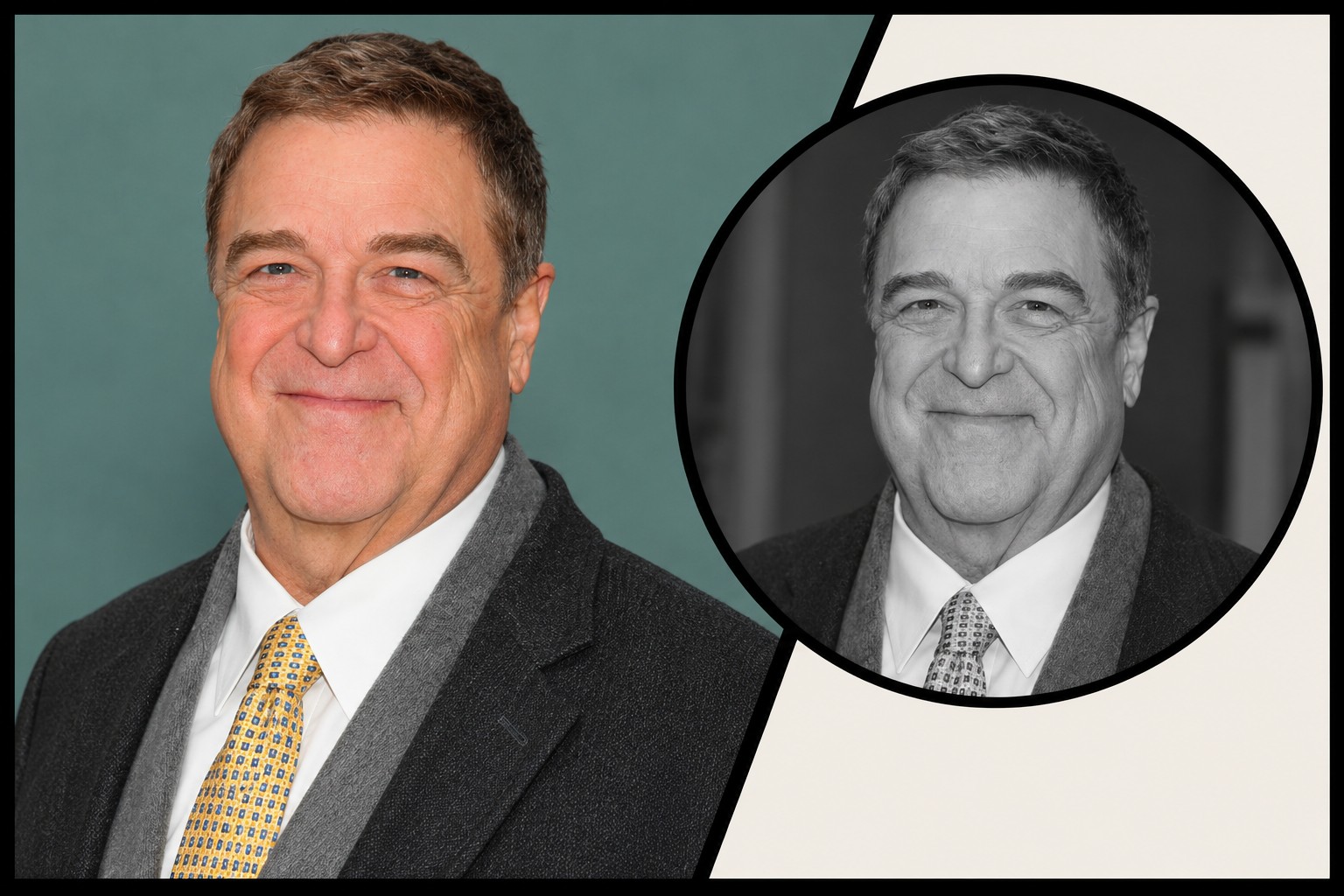
John Goodman can provide the reassuring centre of a family sitcom or make an apparently friendly stranger deeply unsettling. His career includes Dan Conner in Roseanne and The Conners, memorable collaborations with the Coen brothers and the voice of Sulley in Monsters, Inc.
The range is connected by an unusually strong command of rhythm and physical presence. Goodman can make a scene feel relaxed, chaotic or threatening without losing the sense of a specific person inside it. His biography traces the development of that skill from Missouri and university theatre to New York, film, television and a long working relationship with audiences.
Quick facts
| Full name | John Stephen Goodman |
| Born | 20 June 1952 |
| Birthplace | Affton, Missouri, United States |
| Education | Southwest Missouri State University, drama degree, 1975 |
| Profession | Actor and voice actor |
| Spouse | Anna Beth “Annabeth” Hartzog; married in 1989 |
| Child | Daughter Molly |
| Familiar roles | Dan Conner, Walter Sobchak and the voice of Sulley |
Growing up in Missouri
Goodman was born in Affton, near St Louis, Missouri. His father died while he was young, and his mother worked to support the family.
He attended Affton High School and developed interests in both sport and performance. The combination is useful context for an actor whose physical confidence would later become an important part of his screen work.
His early life did not point directly towards Hollywood. Like many performers, he moved through school activities and changing ambitions before professional acting became a practical goal. The familiar authority of his later performances was built through experience rather than arriving fully formed with his first major role.
Football, university and drama
Goodman attended Southwest Missouri State University, now Missouri State University, initially on a football scholarship. He shifted his attention towards drama and graduated in 1975.
University theatre gave him opportunities to work with different texts and learn the demands of rehearsal and live performance. It also offered a community in which acting could become a serious professional ambition.
Missouri State’s account of his Bronze Bear recognition documents his continuing connection with the institution. His support for its performing-arts facilities shows that the university remained more than a line in a résumé after his career became successful.
Moving to New York
After university, Goodman moved to New York to pursue acting. He worked through auditions, commercials and theatre before developing a substantial screen career.
That period required persistence without any guarantee of a breakthrough. A young actor has to find work, maintain skills and keep presenting himself for roles while learning how the profession actually operates.
The experience also encouraged adaptability. Advertising, stage performance and small screen parts require different scales of expression. Learning when to make an action larger and when to reduce it became particularly useful for Goodman, whose natural physical presence could otherwise dominate every scene.
Early films and Raising Arizona
Goodman’s early film work included a range of supporting roles before Raising Arizona brought him into the world of Joel and Ethan Coen. Released in 1987, the film used his energy within a heightened comic style.
The Coens’ scripts often give characters precise verbal habits and an unusual relationship with the world around them. Goodman could commit to that language while keeping the person physically convincing.
Raising Arizona began a collaboration that became central to his film career. Its significance is not simply that one role led to another. It established a shared understanding between actor and filmmakers about tone: a scene could be absurd, forceful and carefully controlled at the same time.
Dan Conner in Roseanne
Roseanne premiered in 1988, with Goodman playing Dan Conner. The series placed a working-class family and its practical pressures at the centre of a major network comedy.
Dan’s humour is closely connected with fatigue, affection and the need to keep everyday life moving. Goodman gives the character enough warmth to anchor the family without making him endlessly patient or free from mistakes.
His work earned a Golden Globe and multiple Emmy nominations. The ABC biography documents that recognition. The role became familiar because its conflicts often concerned recognisable things: money, parenting, work and the effort of remaining close while managing all three.
Returning to Dan in The Conners
Goodman continued the character’s story in The Conners. Returning to a long-established role requires more than repeating familiar gestures, because the character and the people around him have aged.
The later series allowed the family to encounter new circumstances while retaining a shared history. An actor can draw on that history through the way a character listens or reacts, without needing every earlier event to be explained.
Dan’s continuity also illustrates the unusual relationship between sitcom performers and audiences. Viewers may watch a character across decades, associating him with different stages of their own lives. Goodman made that familiarity useful while still allowing frustration, grief and change to affect the performance.
Barton Fink and the Coen brothers
In Barton Fink, Goodman played Charlie Meadows, a character whose apparent friendliness gradually becomes harder to interpret. The role depends on keeping more than one possible reading alive.
He later appeared in The Big Lebowski, O Brother, Where Art Thou? and Inside Llewyn Davis. Each film uses his voice and presence differently, from aggressive comic certainty to a more corrosive kind of authority.
The collaboration shows the value of trust between filmmakers and an actor. Goodman can make large choices because the surrounding film supports a precise tone. The result is not simply excess; it is performance shaped to a particular fictional world.
Walter Sobchak in The Big Lebowski
Walter Sobchak is one of Goodman’s most recognisable film characters. His certainty, anger and insistence on rules create repeated problems for the people around him.
The comedy comes from the mismatch between Walter’s sense of proportion and the actual situation. Goodman makes the emotional investment convincing, so the character does not seem aware that he is participating in a joke.
Walter’s friendship with the Dude also gives the performance more than a series of outbursts. Loyalty and exasperation coexist, and the relationship continues despite the disruption. That combination helps explain why the character remains memorable beyond individual lines or scenes.
Sulley and voice performance
Goodman voices James P. “Sulley” Sullivan in Pixar’s Monsters, Inc. and Monsters University. The role connects a physically imposing animated character with a warm and emotionally responsive voice.
Voice acting removes many tools available in live action. The performer cannot rely on a personal facial expression reaching the audience directly; rhythm, breath and vocal intention must work with the animators’ images.
Sulley’s relationship with Mike Wazowski, voiced by Billy Crystal, gives the films a strong comic partnership. The differences between their voices help define the characters, while the performances allow friendship and concern to remain audible beneath the jokes.
Other films and dramatic range
Goodman’s filmography also includes The Flintstones, The Artist, Argo, Flight and 10 Cloverfield Lane. These projects range from broad family entertainment to suspense and adult drama.
In 10 Cloverfield Lane, his character’s claims of protection are inseparable from questions about control and trust. The audience has to assess what he says against how he behaves, making small changes in tone unusually important.
His supporting roles in ensemble films show a different form of control. A performer can contribute authority, humour or unease without taking over the whole story. Goodman’s ability to adjust the size of a performance is as significant as his ability to make a large impression.
Television beyond the Conner family
Goodman’s television work includes Treme, Alpha House, Studio 60 on the Sunset Strip and The Righteous Gemstones. These series place him in different social worlds and use his authority for different dramatic purposes.
He won an Emmy for a guest performance in Studio 60 on the Sunset Strip. The Television Academy’s awards record provides the formal details.
As Eli Gemstone in The Righteous Gemstones, he becomes the patriarch of a family whose public religious enterprise is entangled with wealth and personal conflict. His presence can give the surrounding chaos a centre while still allowing the audience to question the authority he represents.
Stage work and live performance
Goodman has continued to work in theatre, including productions of Waiting for Godot and The Front Page. Returning to the stage requires sustained performance rather than scenes assembled from separate takes.
Theatre also changes the relationship with other actors. Timing develops in front of an audience, and a reaction may need to travel farther while remaining connected to the character.
That experience helps explain why his screen work can be both bold and disciplined. A large gesture is not automatically imprecise. When the actor understands its purpose and timing, it can communicate a clear emotional action as effectively as a quiet close-up.
Annabeth Hartzog and family life
Goodman married Annabeth Hartzog in 1989, and they have a daughter, Molly. He met Annabeth while working in Louisiana, a place that became important in his life beyond the film set.
His family relationships are separate from the often turbulent households he portrays. Dan Conner and Eli Gemstone may shape how audiences imagine him, but neither is a documentary account of his marriage or parenting.
Disney’s career profile records his connection to New Orleans alongside his work. Publicly documented family facts provide useful context without requiring speculation about private routines or finances.
Net worth and the value of versatility
Goodman’s earnings include television, film, voice work and theatre. A long list of successful productions does not establish an exact personal net worth, because contracts, taxes, expenses and investments are not fully visible to the public.
His professional achievement is more clearly measured through the variety and durability of his roles. Dan Conner, Walter Sobchak and Sulley are widely recognised, yet they do not feel like the same character moved into different costumes.
The connecting quality is conviction. Goodman makes each person’s immediate concern matter, whether that concern is a family bill, an absurd argument or the safety of a child. That seriousness inside the performance allows comedy and drama to share the same strong foundation.
Frequently asked questions
Where was John Goodman born?
He was born in Affton, Missouri, near St Louis, on 20 June 1952.
What did John Goodman study at university?
He earned a drama degree in 1975 from Southwest Missouri State University, now Missouri State University, after initially attending on a football scholarship.
Who does John Goodman play in Roseanne and The Conners?
He plays Dan Conner, the family patriarch whose humour and practical struggles became central to both series.
Does John Goodman voice Sulley?
Yes. He provides Sulley’s voice in Monsters, Inc. and Monsters University, opposite Billy Crystal as Mike Wazowski.
Who is John Goodman married to?
He married Annabeth Hartzog in 1989. They have a daughter named Molly.
