


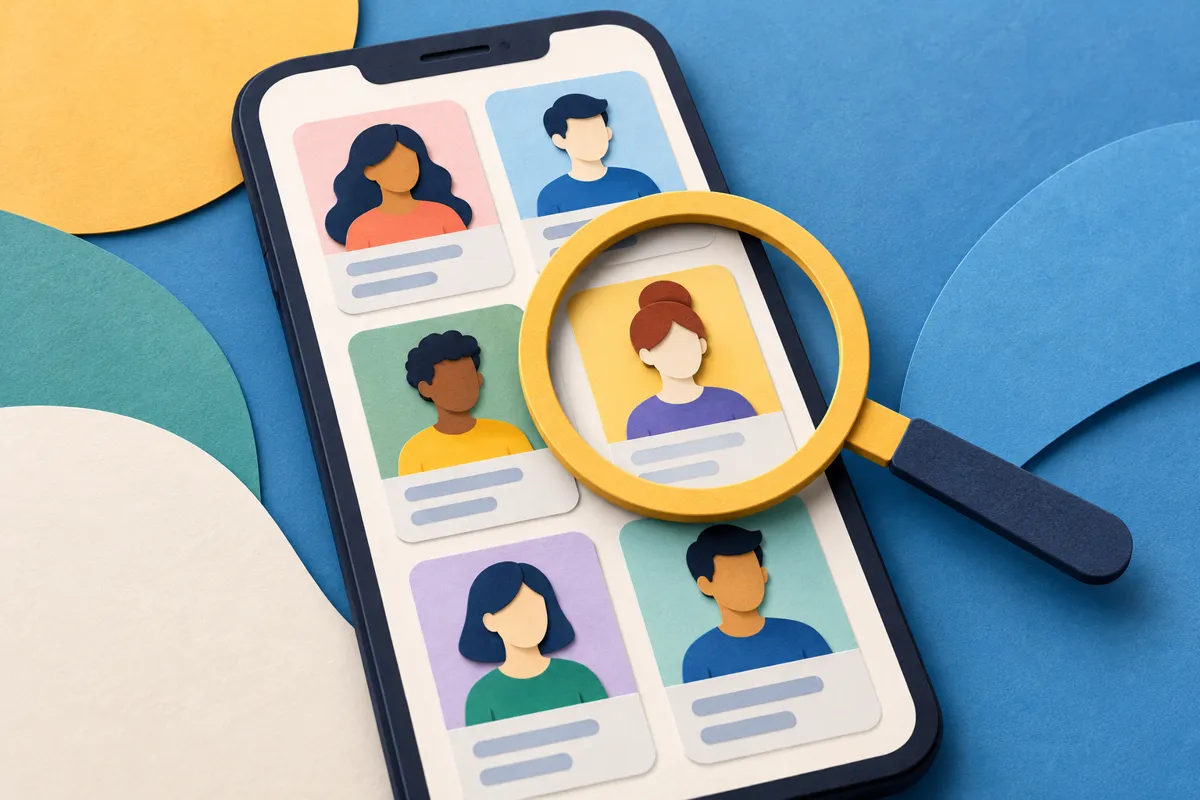
InstaPV is a name used for a third-party Instagram viewing service. The site reviewed here is instapv.ai, which describes tools for viewing publicly available profiles and media without using an Instagram login. That description should be read alongside its privacy policy and feature limitations. A claim about staying off a story’s viewer list is narrower than a promise that no information about your visit is collected.
This guide examines the service’s own documentation rather than presenting an independent security test. The illustrations are AI-generated editorial concepts, not screenshots or evidence that every advertised feature has been tested.
What the InstaPV documentation says
The InstaPV FAQ describes public-profile viewing, recent post previews and additional paid features. It says the service does not require an Instagram password and does not provide access to private accounts. The page distinguishes Free, Profile Pro and Premium Viewer access, with deeper browsing and downloads associated with the premium offering.
These are the provider’s statements about its service. They do not demonstrate uninterrupted availability or independent verification of every result. When evaluating a viewer, identify the exact feature you need and check its current description rather than treating a broad homepage slogan as a specification.
| Question | What to examine |
|---|---|
| Which site is being discussed? | The complete domain and its own documentation |
| What content is covered? | Public content and stated availability limits |
| Is an Instagram password required? | The provider’s stated login requirements |
| What does anonymous mean here? | The particular activity the claim concerns |
| What data may the viewer collect? | Its privacy policy and account settings |
| Are downloads included? | The current plan and feature description |
Separate viewing claims from data collection
The privacy policy describes collecting technical and usage information, including device details, interactions and search queries. It also describes approximate location inferred from an IP address, cookies and browser storage. Registered accounts and subscriptions involve additional information. The policy says the service is not affiliated with Instagram or Meta.
That matters because two different relationships are involved: your interaction with the viewer website and the viewer’s presentation of Instagram content. A claim about the second relationship does not erase the first. This review has not audited the service’s code, network traffic or data-retention implementation.
Before entering a search, decide what information you are comfortable sharing with that website. If the purpose is simply to confirm a business’s public contact details, its own website may answer the question without an additional intermediary.
Do not enter your Instagram password into an unrelated viewer. If an account credential has already been reused or exposed, change it and enable an additional sign-in factor; the US Federal Trade Commission’s two-factor authentication guidance explains why a second verification step can reduce account-takeover risk.
Check the exact destination
Similar names in search results are not proof of common ownership. Preserve the domain in your notes and bookmarks. A review written about one address should not automatically be applied to another address using similar wording, a matching logo or a familiar layout.
For a practical comparison, create two columns: the page you opened and the evidence connecting it to the service you intended to find. A link from the provider’s own documentation is a useful lead. A copied paragraph on an unrelated blog is weaker evidence. If the connection remains unclear, describe it as unclear rather than inventing a merger or rebrand.
Our Nerwey reader guide uses the same article-level approach to unfamiliar websites. A polished presentation helps navigation, but it does not independently establish ownership, testing quality or privacy practices.
Compare plan boundaries before paying
Write down the exact task you want to complete. “View a recent public post” and “browse older media” may fall under different limits. Compare the current plan descriptions against that task. A feature existing somewhere in the product does not mean it is included in the tier you are considering.
The service terms describe automatically renewing subscriptions and cancellation arrangements. They also state that content availability and accuracy are not guaranteed. Review the current checkout and terms before making a purchase, including the billing period and how cancellation works.
A useful personal checklist records the feature, expected frequency of use and the point at which you would stop paying. This keeps a small research task from turning into a subscription chosen only because a preview stopped loading.

Understand missing or inconsistent results
A missing image does not establish that a person blocked you, deleted an account or changed a relationship. There may be several explanations for unavailable content, and a third-party viewer does not necessarily provide enough evidence to distinguish them.
Check ordinary details first: the spelling of a public username, whether the original source is still available and whether the feature belongs to the current plan. Avoid repeatedly submitting slightly different queries to turn an uncertain result into a confident personal conclusion.
For research about an organization, record the date and the exact page you used. If a number matters, such as a publicly displayed follower count, identify it as an observation from that source at that time. Do not present it as a permanent measurement or proof of audience quality.
Respect the boundary around private content
The service’s public-only description is an important limit. A private account requires the account holder’s approved access route; a third-party page should not be treated as a way around that choice. Claims promising secret access deserve careful scrutiny.
Instagram’s own public and private account guidance explains that approved followers can see private-account posts, while anyone on Instagram can see posts from a public account. That platform-level distinction is a more reliable boundary than a third-party claim promising access beyond it.
Downloading or seeing public material also does not automatically grant permission to republish it. For an article, marketing asset or commercial presentation, obtain the permissions appropriate to the intended use and retain the creator’s attribution where required. This is a practical distinction between access and reuse, not a legal assessment of a particular item.
The source-checking process in our WhatsOnTech guide can help when technology coverage blurs those separate questions.

Frequently asked questions
Is InstaPV an official Instagram service? The reviewed privacy policy says it is not affiliated with Instagram or Meta. Treat it as a separate website with its own policies.
Does anonymous mean that no data is collected? No. Read the specific claim alongside the privacy policy, which describes technical and usage data collection.
Can it legitimately reveal private-account content? The reviewed FAQ says it covers public content and does not provide private-account access.
Has every feature been independently tested here? No. This guide reviews public documentation and identifies the limits of that evidence.
Define the task before using the viewer
The most useful InstaPV assessment begins with a clear purpose, an exact domain and a careful reading of the relevant feature. Keep public-content access, website data collection and reuse permissions separate. That gives you a more accurate basis for deciding whether a third-party viewer is appropriate for the information you need.
