


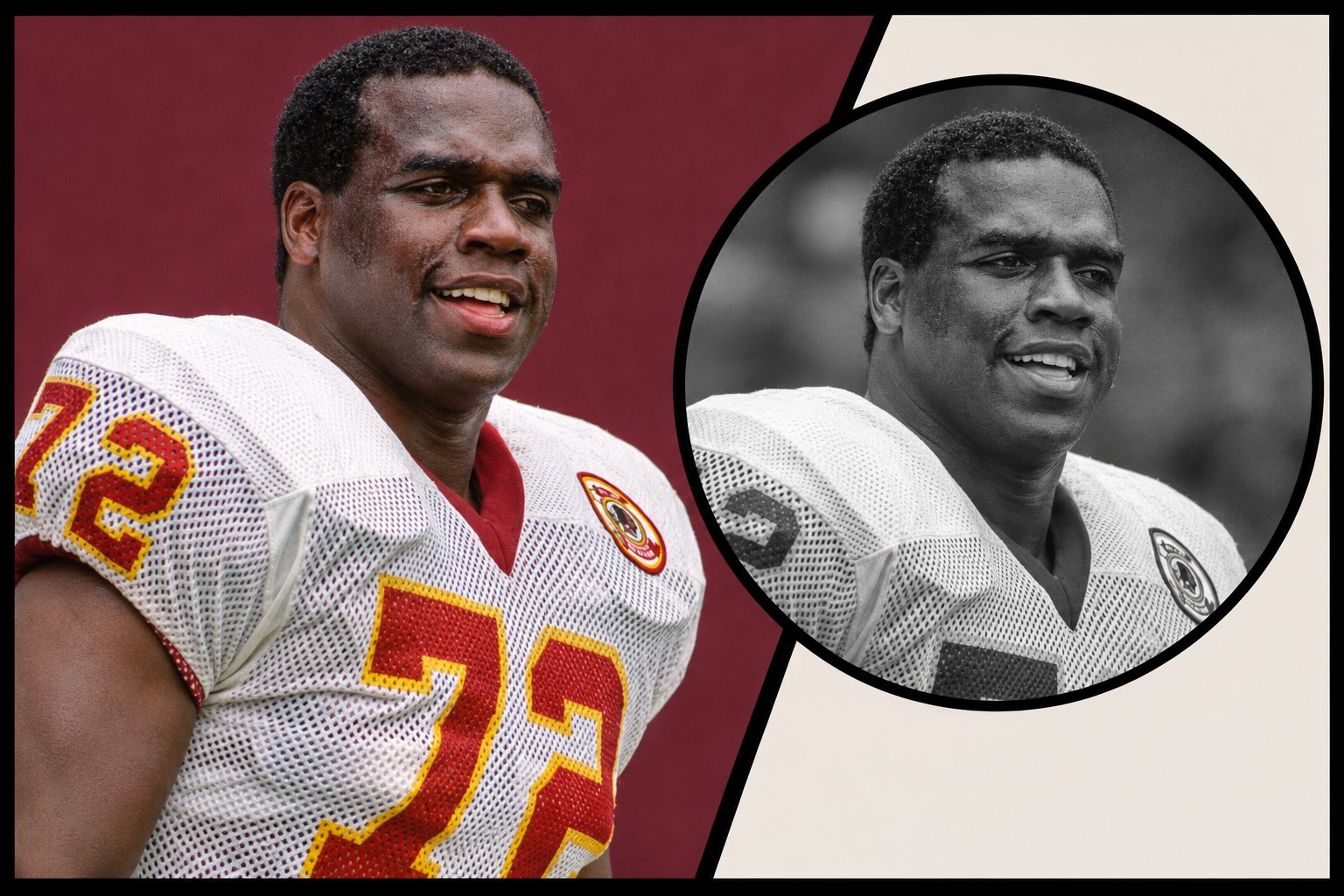
Dexter Manley’s name remains associated with Washington football’s championship years. A powerful defensive end with a memorable personality, he became one of the franchise’s best-known players of the 1980s.
His exact current net worth is not publicly verified by the sources reviewed for this article. Historical contract reporting documents part of his playing career, but it does not provide a complete account of his finances decades later.
A useful profile therefore looks at both sides of the question: what his football record establishes, and why career earnings should not be mistaken for present personal wealth.
Quick facts
| Name | Dexter Manley |
| Profession | Former professional football player |
| Position | Defensive end |
| College | Oklahoma State |
| Washington years | 1981–1989 |
| Draft | Fifth round, 1981 |
| Major honours | Two Super Bowl championship teams and 1986 Pro Bowl |
| Nickname | Secretary of Defense |
| Exact current net worth | Not publicly verified |
| Later public work | Literacy advocacy |
What is Dexter Manley’s net worth?
The reviewed sources do not establish a reliable current net-worth figure. Online estimates may assign one, but they generally do not show a complete accounting of assets and liabilities.
That limitation matters especially for a retired athlete whose best-known contracts belong to another era. A career can include substantial earnings without those earnings remaining intact as personal wealth.
Taxes, expenses, changes in employment and financial obligations all affect what someone retains. Without documented information about those factors, a precise total would be speculative.
This article therefore does not present an unsourced estimate as fact. It focuses on identifiable career milestones and the financial information that can be placed in context.
What historical contract reporting tells us
A 1986 Washington Post report put his four-year Washington contract at nearly $1.6 million.
A contract report is a snapshot of an agreement at a particular time. It is not a personal balance sheet, and the headline value should not be treated as cash still owned by the player.
More generally, sports contracts can contain conditions and different payment components. A financial profile should distinguish the reported agreement from verified money received, money retained and present asset values.
The historical reporting gives useful context for his professional standing. It does not resolve the current net-worth question.
From Oklahoma State to the NFL
Manley played college football at Oklahoma State before Washington selected him in the fifth round of the 1981 draft.
The team’s retrospective on his pass-rushing career describes his early role as a pass-rushing specialist before he moved into the starting lineup.
That progression is an important part of his career story. He was not simply handed a place as a famous defensive leader; his professional role developed after entering the league.
For a defensive end, earning a larger role means contributing within a unit as well as producing individual plays. Pass rushing, run defence and the responsibilities of nearby teammates have to fit together.
Why his pass rushing stood out
A defensive end can influence a play even without recording a sack. Pressure can hurry a throw, force a quarterback to move or create an opportunity for another defender.
Manley’s reputation centred on a combination of speed, strength and intensity. Washington’s historical coverage presents him as a disruptive presence who demanded attention from opposing offences.
The individual sack total is therefore one measure of a broader role. It records a particular outcome, while the demands placed on blockers and the effect on an offence can extend beyond that number.
This helps explain why supporters remember certain defenders so vividly. A forceful pass rusher can change the rhythm of a game and become a defining part of a team’s identity.
The 1986 season
Washington’s official historical profile records 18.5 sacks for Manley in 1986 and his Pro Bowl selection that year.
Those achievements make the season a clear high point in his playing résumé. They are concrete sporting facts rather than broad descriptions of fame or popularity.
They also explain why financial interest followed his career. A player producing at that level is highly visible to fans, media and the organisation for which he plays.
Still, an honour does not disclose the amount of a bonus or an endorsement agreement. Sporting success and individual compensation remain related but separate subjects.
Championship football in Washington
Manley was part of Washington teams that won Super Bowls following the 1982 and 1987 seasons. His career belongs to a period that remains central to the franchise’s history.
Championships are collective achievements. A defensive player’s contribution can be substantial even when the most frequently replayed highlights involve a quarterback or running back.
The defence’s work affects field position, possession and the opportunities available to the offence. A successful team depends on those contributions across different phases of the game.
For Manley, the championship connection is one reason his public profile has lasted well beyond his active playing years.
A memorable postseason contribution
In its account of a 2007 tribute, Washington revisited Manley’s role in the NFC Championship victory over Dallas that sent the team to Super Bowl XVII.
The account describes his pressure on the Cowboys’ quarterbacks and a tipped pass that Darryl Grant intercepted and returned for a touchdown.
A play like that illustrates how individual actions combine. The defender who disrupts the pass and the teammate who finishes the return share in the result.
It also helps explain the emotional strength of sporting memory. Supporters may remember one sequence for decades because it is tied to a championship opportunity and a long-standing rivalry.
Reading sack statistics carefully
Historical football records need context. Washington’s retrospective material credits Manley with a franchise total of 97.5 sacks, while the league began recognising sacks as an official individual statistic in 1982.
Different summaries can use different counting periods or distinguish team records from league career statistics. A number should therefore be accompanied by its source and scope.
This profile uses the figure as it appears in the team’s historical material rather than combining several databases into an unexplained total.
The principle is the same as with contract figures: precise numbers are most useful when readers know exactly what they measure.
Life after the most famous playing years
Manley’s football career continued beyond his Washington tenure. A 2023 Montgomery Magazine profile discusses later seasons with the Phoenix Cardinals and Tampa Bay Buccaneers, followed by time in the Canadian Football League.
The same interview places substantial emphasis on his later literacy work rather than treating retirement as the end of his public story.
That broader view is important. A former athlete’s identity can include advocacy, family and community work as well as the performances for which supporters first knew him.
It also cautions against assuming that every later appearance represents a documented paid engagement. Public activity and disclosed income are not the same thing.
His public discussion of reading difficulties
Manley has publicly discussed the reading difficulties he experienced during his education and playing career. Montgomery Magazine’s interview recounts his 1989 Senate testimony and his later work on literacy.
The significance is not that a public figure must be reduced to a difficulty he faced. It is that he chose to speak about an experience that could help others feel less isolated.
Washington’s own historical profile records learning to read as an achievement he regarded as especially important.
That statement places his personal priorities alongside the football honours. The trophies and statistics form one part of his story; learning and advocacy form another.
The Dexter and Lydia Manley Foundation
The 2023 profile describes the Dexter & Lydia Manley Foundation supporting literacy organisations in the Washington area, including an emphasis on mentoring and programmes with demonstrated results.
The work connects his own experience with practical support for others. It gives his post-football public life a focus that is distinct from nostalgia for his playing days.
A foundation’s activity should not be confused with an individual’s wealth. Funds associated with a charitable organisation are not automatically personal assets belonging to its founders.
This distinction is essential in any net-worth article that mentions nonprofit work. The purpose and finances of an organisation must remain separate from the private finances of a person associated with it.
Why present wealth cannot be reconstructed from highlights
A successful season, a championship ring or a familiar nickname establishes sporting significance. None supplies a complete record of current assets.
The same applies to a photograph at an alumni event or an interview in an attractive setting. Images do not reveal ownership, debts or the financial arrangements behind a location.
It is also inappropriate to turn past personal difficulties into a precise claim about current finances without evidence. A difficult period does not establish a present balance sheet.
For Manley, the available record supports a substantial football biography and a meaningful account of later advocacy. It does not support an exact current fortune.
The career behind the search
Manley’s public legacy includes explosive defensive play, championship teams, a memorable place in Washington football and openness about literacy.
Those are the strongest foundations for understanding why people continue to search for him. The financial question should be answered with the same care used for the sporting record.
The exact net-worth figure remains unverified. His career, however, can be described through specific achievements, dated reporting and his own public priorities rather than through an unsupported estimate.
Frequently asked questions
What is Dexter Manley’s net worth?
His exact current net worth is not publicly verified by the sources reviewed for this article.
What position did Dexter Manley play?
He played defensive end and became particularly known for his pass rushing with Washington.
Did Dexter Manley win a Super Bowl?
He was part of Washington’s championship teams following the 1982 and 1987 seasons.
Why is 1986 important in his career?
Washington’s historical records list 18.5 sacks and a Pro Bowl selection for that season.
What has Dexter Manley done beyond football?
His public work has included literacy advocacy, including activities associated with the Dexter & Lydia Manley Foundation.
